viernes, 17 de diciembre de 2010

Global Warming

Global warming isn’t necessarily an issue to worry about, because the Earth has gone through lots of cycles of temperature change. However, global warming means a fast temperature increase due to humans’ contribution with noxious gases, which produce what is known as the Greenhouse Effect. This effect is described as the process by which these gases allow sunlight to enter the atmosphere, but prevent heat from escaping it. Such condition is mostly result of burning fossil fuels, like coal and oil, yet they are the most used energy sources for everyday activities.
It is true that global warming is cause by those greenhouse gases, but it is also true that human beings are responsible for them. Thinking that it’s as simple as casting publicity about global warming and how bad it is for the planet, it’s no way close to the solution for it. People may see some TV commercials, and about five minutes later the idea is totally gone. Moreover, the main problem may be humans’ nature, it’s impossible to make everyone stop polluting; humans’ have a lot of created needs, and most of them are what is heating the planet.
Many governments are already taking action to stop this situation as much as possible. There are strategies to reduce pollution and greenhouse gases, but they need new technologies that will be available in a few decades. Which are exactly those governments? They may be rich countries, or at least well developed ones. For some reason, less developed countries think that they are back in time from developed ones. If we think about it, here in Costa Rica, you can see an uncivilized country. The problem starts with people, they are the main cause for the causes of this accelerated global warming.
The lack of education about global warming, and ecology itself, is probably the main reason for the Greenhouse Effect. As schools, teachers, and families focus on what is “important”, they don’t have interest on making a better environment, but a better work force for future companies, or already polluting ones. As this world merges even more into capitalism, having a nice job, and making money is what is important now; it’s a nice thought: “Forget about our lives, our children, our future; let’s just put a price on everything we can touch and sell it”. In the end, there is no price for our planet. What’s worth if people die and there’s no one to buy it? It’d be like a failed marketing strategy.
In the very end, humans’ guilt will lead to some sort of solution; but who knows, it may be late by then. People are more than capable to prevent this situation to get worse. Most of our needs are actually unnecessary, but now it’d be hard to get rid of them; what is up to do, is to find alternative ways to live with our current needs. There are non-polluting energy sources, why settle with fossil fuels? Even if we got to use polluting sources, make it more efficient. If little by little the change starts, little by little it’ll be grown up to a major change. We got the possibilities; we need the will force to start.

Bibliography
World View of Global Warming. (2010). Global Warming and Climate Change Explained. Recovered September 20th, 2010 from http://www.worldviewofglobalwarming.org/pages/aboutwarm.html
National Latino Coalition on Climate Change. (2007). What is Global Warming and What Causes It?. Recovered September 20th, 2010 from http://www.latinocoalitiononclimatechange.org/issues/what/
National Geographic. (2010). Global Warming Solutions. Recovered September 20th, 2010 from http://environment.nationalgeographic.com/environment/global-warming/gw-solutions.html

Globalization Week Organizers

San José, Costa Rica.
September 27, 2010.

Globalization Week Organizers,
I recently attended the exposition about “La constante de la globalización: EL Cambio”, and I have to say, it was quite boring. It lasted an hour, and yet the expositor almost made me fall asleep.
The topic about the change been the most common thing and that we should be prepared was interesting, the first minutes; but having to hear about the same for the entire hour was what made me lose interest. He got to a part where he was going to talk about something different, some sort of charts and statistics, but he said it would take too long to explain and we didn’t have time for that.
To be honest, if the speech would have lasted more than an hour, I’d have left the auditorium. This kind of topics are already known be many people, and we are tired of hearing about that. There has to be a change on this matter, so we get to be interested, maybe instead of speeches there can be activities where the students participate.
A couple of days later, I attended to another speech about supply chains (can’t remember the name exactly, but I know you know what I’m talking about) on Intel. For the first half hour, the expositor started talking about Intel, and other companies in the world I don’t know why, then he began speaking about Intel and what it does, and something about that they represent a 3.5% of Costa Rica’s PIB. I had to go, so I couldn’t stay to see if the presentation talked about supply chains at all.
About the first exposition, the change, there has to be some, because if you keep doing this kind of things like that, there won’t be any good learning for the students that may get bored, instead of interested. People keep changing their thoughts, if there’s no change, we won’t accept the same form of expositions.

Thank you for reading, and giving a thought to this matter.
Romano González

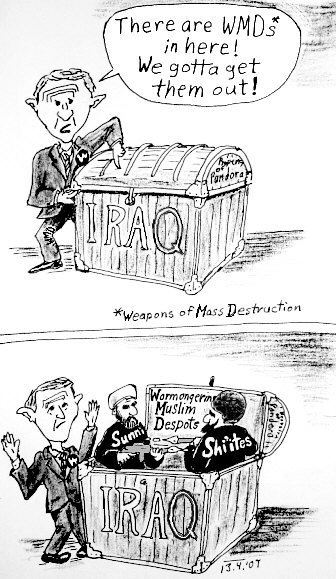
Proliferation of Weapons of Mass Destruction

The proliferation of chemical, biological, radiological, and nuclear weapons, commonly grouped as weapons of mass destruction, as well as their delivery systems (which usually are missiles), is a relatively recent phenomenon in history. Furthermore, what is exactly a WMD or weapon of mass destruction? According to the U.S. Code, Title 5, "War and National Defense," a WMD is "any weapon or device that is intended, or has the capability, to cause death or serious bodily injury to a significant number of people through the release, dissemination, or impact of (A) toxic or poisonous chemicals or their precursors; (B) a disease organism; or (C) radiation or radioactivity."
As chemical and biological weapons are easier and less expensive to produce than nuclear ones, many more states are actively involved in chemical and biological weapons programs, than in nuclear weapons programs. Moreover, technical complexities and expense reduce the likelihood that most terrorist groups could construct a nuclear explosive device. A more likely threat from a terrorist organization would be a radiological one involving the dispersal of radioactive substances to contaminate the air or water, or to render a particular area.
Three types of delivery systems are usually considered for WMD, these are ballistic missiles, cruise missiles, and combat aircraft. Among these, the ballistic missile is the greatest threat because it is extremely difficult to defend against and the time between detection and impact is very limited. Thus, it is no coincidence that virtually all states known to possess or suspected of developing WMD also maintain ballistic missile programs.
Those were basic information about WMD. Keep talking about this would be actually redundant now; so more importantly, why exactly do nations develop WMD? It may be hard to say a single explanation, because it can be listed as follows, or not: national security, balance of power, regional stability, politically powerful commercial defense industries, technological imperatives, and so on.
Most countries that possess nuclear weapons have a "no first strike" policy that calls on WMD for defensive purposes only. They stockpile them because of the enormous and widespread damage and costs of WMD. So, they will not launch nuclear weapons at another country first but only in reaction to an attack against their own nation. This because nobody wishes to start a nuclear/chemical/biological war attacking someone who, they know, have weapon of mass destruction stocked too.
Bibliography
Proliferation of Weapons of Mass Destruction. (2010). Proliferation of Weapons of Mass Destruction (WMD) - History Of Usage And Proliferation, Why Nations Develop Weapons Of Mass Destruction, Chemical Weapons, Biological Weapons. Recovered October 4th, 2010 from http://www.libraryindex.com/pages/213/Proliferation-Weapons-Mass-Destruction-WMD.html
Proliferation of Weapons of Mass Destruction. (2008). Proliferation of Weapons of Mass Destruction. Recovered October 4th, 2010 from http://www.csis-scrs.gc.ca/prrts/prlfrtn/index-eng.asp

Discrimination

Ethnic discrimination is just a minor issue to talk about, that’s why this essay will go beyond this and get to discrimination in general. Even if we realize and make up our mind to try and not discriminate someone we wouldn’t stop that easy. Through history there has been racism, slavery, ethnic superiority, etc; but we are humans, and that is something we can’t help. Within this essay will be some historical facts in the US, explain a little about why discrimination can’t be solved; and give examples about it in Costa Rica.
Discrimination has influenced wars, slavery, the formation of nations, and legal codes. Racism, an example of discrimination, has existed throughout human history. The most notorious example of this dates from 500 years ago, the slavery of people, particularly Africans, in the New World. In the US history, there has been wars to stop discrimination. Back in the 1860s, President Lincoln worked hard, during the civil war, to abolish slavery. Furthermore, there have been fights worldwide too, for this and many other reasons, subject to equity in human kind. Discrimination has been the reason for many things, and it doesn’t seem to have an end.
There may be laws and regulations in order to avoid it in many ways, but there’s no stop to discrimination when it comes to people’s, either individual or group, thinking. As everyone has their own minds, education, and points of view; there is also a massive thinking phenomenon called “social groups”. Actually, someone may be able to not discriminate (which would be very odd), but when a social group tend to think in one way about something, that someone will be forced to think alike. It doesn’t matter if we are taught to not discriminate, doesn’t stand how polite we may be; living in society will make us feel uncomfortable about some stranger we met in a single occasion, that will come to be irrational ideas, and end up as discrimination for some illogical reason. Also, religion teaches us to discriminate. Think of the Catholic Church, it has spent a few decades to try and make people think some music genres are evil. Isn’t that discrimination too?
In Costa Rica (as a specific example, not that everywhere else is not like this), discrimination is an everyday matter for everyone. Imagine going by the sidewalk, and then u notice a random guy with a hoodie coming to you; you’ll probably think he’s going to rob you because probably he is a gang member or something. We use to believe that everything have a general order in society, like major groups, and that’s exactly what makes people have a wrong first impression about someone. Costa Rica is a mainly catholic country and as said, that makes people more discriminatory, making it an everyday issue.
In general, people think of discrimination as a bad thing for everyone, but it’s not, what’s bad is to close one’s mind and hope everything will always be the same. Now, discrimination is always the same for every kind, ethnic, racial, social, political, etc; it is discrimination no matter what it’s about. But, is there a way to end with this? There is probably no way to solve it. Yet tolerance and patience are a way to help it; nothing will make a sudden stop to discrimination, but they can start the change that will lead to the world we are taught to create.

It is worthy to be tough

Crimes have existed since ever; take for example the witch hunting during Inquisition. Those were women guilty of irrational crimes, but crimes anyway for the people of that age. Societies were made based on mutual arrangements to keep order and punish crimes. Nowadays, societies remain, but they can’t maintain order because they lack the strength to punish criminals; they are scared of been tough and use extreme solutions (dead penalty), or don’t know what their government is supposed to do. It is worthy for government to teach societies that they can keep peace at any cost.
Most democratic societies fear their government, people’s life is ruled by the government, where it should be the opposite, it’s something to take advantage of. People fear jail, but it is hard to be imprisoned or easy to get out. There aren’t enough policemen watching out, and this makes crimes increase. An inflexible government applying severe punishment will increase fear of committing crimes instead, so there may be fewer crimes in the end.
            Dead penalty and torture are solutions, as people fear death and pain. Moreover, according to Sigmund Freud, in his book “The Discomfort of the Culture” (Das Unbehagen in der Kultur in german); people are scared of the authority because they are scared to be punished. More severe punishments will cause people not to commit crimes. But as long as everyone obeys the law, no one have anything to be scared of. Governments are supposed to take care of their people. They need to be honest, there must be equity, this means equal punishments no matter social status; and fairness, accidents happens, so severe punishments are for well-studied cases whose psychological status prove that they can’t live in society
Governments are meant to keep society in order, so those who can’t live in society must not remain in it. As a variant of Darwin’s Natural Selection, this is what I call “Society’s Natural Selection.” Humans are the most adaptable species in the planet, we should be able to adapt to different rules. Those that don’t contribute to society mustn’t be alive, yet we still keep them in jail. Although, the idea is not to fear the government, but breaking the law. Governments can take responsibility by infusing education, maintaining stability, and granting freedom to their people.
In the end, severe punishment will only be the last resource to keep order once societies have learned how to live peacefully. Fear will have transformed into stability, and governments will improve in every way because of good societies. Why does dead penalty has to be bad, when it can reduce crimes, stabilize and improve societies, and make better countries?

Terrorisms

We think of terrorism as an act of violence from people of one nation striking another. Terrorism goes beyond that, it “refers to the use of violence for the purpose of achieving a political, religious, or ideological goal.” Among many types of terrorism, this essay will talk about two: state terrorism and nationalist terrorism. This will show some common, yet contrasting, characteristics of both.
As a start, will be described the characteristic of: who are each type of terrorism linked to. First, the state terrorism; it isn’t usual to hear about terrorism been linked to a nation’s government, but this type is related to it. It has the government support or is a “state-sponsored” group. Then, the nationalist terrorism, is what is more common to hear, because it is related to identifying group, such as an ethnic, national, religious, etc. Also, it is very dependent to the feelings of its members.
Next on the list, their motivation, what moves them to form terrorist groups? The state terrorism has its motivation in domination. Dominating people, certain groups, or a whole nation is their goal. On the other hand, the nationalist terrorism emphasizes on nationalism. These groups have a strong feeling for their land, culture, traditions; so they fight for them.
The third characteristic, what they seek, their vision. The nationalist terrorism seeks to form self-determination among its members. They want everyone to build a bond to their cause. However, the state terrorism doesn’t seek anything like that. It seeks to achieve a political objective (mostly) and obtain obedience through terror and repression, with violent acts or threats.
To finish, the last characteristic this essay will talk about, what or who they oppose. The nationalist terrorism opposes to several things, among them: empires, occupying (foreign military established in certain country where they shouldn’t be), illegitimate power and immigrations. These examples go against the nationalist goal. Also, there is an interesting fact (more a coincidence actually), the nationalist terrorism oppose to the state’s vision. The state terrorism opposes to domestic and external enemies, meaning actually, anything o anyone who oppose them.
It’s not like there has to be several types of terrorism in one single country, because it’d be odd; but it may happen, and there can be heavy conflicts with these two types. Terrorism itself is a way to solve conflicts, not a civilized way though. Although, human kind have shown the skill to solve problems through discussion, yet there may be some people that feels the king of the world and do whatever they want, and that causes revolutions. Terrorism breaks out the say: “Treat the others as you’d like to be treated.”
Romano González

Peacemaking and peacebuilding

Peace is actually achieved through an easy to explain, yet hard to do, process. Everything start with a peacekeeping entity, such as UN (United Nation), who tries create a cessation if violent conflicts. Then, there is something called “peacemaking” going on between the conflictive parties. And last, the peacebuilding process, to ensure that no more conflicts will happen.
Peacekeeping means to keep people from attacking each other by using some kind of barrier between them. [1] Often this barrier is made up of neutral soldiers (called “peacekeepers”) from neutral nations or the UN for example. Those soldiers do nothing to solve the conflict but to secure and suspend violence. Such part of the process can be exemplified in the movie “Invictus” with the secret service of the president Mandela. Their job was to make sure nothing will go wrong, they knew that there was needed peace to solve any conflict and that they were in charge of keeping peace.
Once established the peacekeepers, and the violence is already in cessation, the part of peacemaking comes in. “Is the process of forging a settlement between the disputing parties.” [2] This settlement can be done by the two sides, although there can be a third-party mediator, who assists the process and helps to draft a workable peace accord. In the essence of peace, peacemaking is where it starts, arguing to solve conflicts. Peacekeeping is just meant for when there has been already an armored confrontation, yet peacemaking comes as we’ve seen in the current conflict of Costa Rica- Nicaragua, there has been no violence yet.
After peacemaking, it starts the very test of the settlement: the Peacebuidling. It is a long-term process that occurs after a violent conflict has slowed down or has come to a halt. It is generally agreed that the central task of peacebuilding is to create positive peace, a "stable social equilibrium in which the surfacing of new disputes does not escalate into violence and war." Peacebuilding measures also aim to prevent conflict from reemerging, as it is highly possible to happen if there hasn’t been a mutual arrangement in a previous conflict. “In short, parties must replace the spiral of violence and destruction with a spiral of peace and development, and create an environment conducive to self-sustaining and durable peace.” [3]
In the end, what makes us all humans is the capability of understanding and empathy. Even if human kind has faced many conflicts through history, most of them have come to an agreement thanks to a logical and mutual solution. As there is peacemaking and building, there is only one thing that has to prevail and that is peace itself. A peaceful world comes to mutual support, and therefore, progress for mankind.

Bibliography
            [1] International Online Training Program on Intractable Conflict. (1998). Peacemaking. Recovered on December 08 2010 from http://www.colorado.edu/conflict/peace/treatment/peacemkg.htm
            [2] Beyond Intractability. (2010) Peacemaking. Recovered on December 08 2010 from http://www.beyondintractability.org/action/essay.jsp?id=28716&nid=1325
            [3] Beyond Intractability. (2010) Peacebuiling. Recovered onDecember 08 2010 from http://www.beyondintractability.org/action/essay.jsp?id=28721&nid=5154