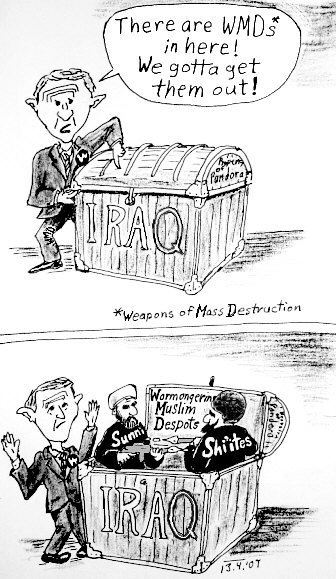
The proliferation of chemical, biological, radiological, and nuclear weapons, commonly grouped as weapons of mass destruction, as well as their delivery systems (which usually are missiles), is a relatively recent phenomenon in history. Furthermore, what is exactly a WMD or weapon of mass destruction? According to the U.S. Code, Title 5, "War and National Defense," a WMD is "any weapon or device that is intended, or has the capability, to cause death or serious bodily injury to a significant number of people through the release, dissemination, or impact of (A) toxic or poisonous chemicals or their precursors; (B) a disease organism; or (C) radiation or radioactivity."
 As chemical and biological weapons are easier and less expensive to produce than nuclear ones, many more states are actively involved in chemical and biological weapons programs, than in nuclear weapons programs. Moreover, technical complexities and expense reduce the likelihood that most terrorist groups could construct a nuclear explosive device. A more likely threat from a terrorist organization would be a radiological one involving the dispersal of radioactive substances to contaminate the air or water, or to render a particular area.
Three types of delivery systems are usually considered for WMD, these are ballistic missiles, cruise missiles, and combat aircraft. Among these, the ballistic missile is the greatest threat because it is extremely difficult to defend against and the time between detection and impact is very limited. Thus, it is no coincidence that virtually all states known to possess or suspected of developing WMD also maintain ballistic missile programs.
Those were basic information about WMD. Keep talking about this would be actually redundant now; so more importantly, why exactly do nations develop WMD? It may be hard to say a single explanation, because it can be listed as follows, or not: national security, balance of power, regional stability, politically powerful commercial defense industries, technological imperatives, and so on.
Most countries that possess nuclear weapons have a "no first strike" policy that calls on WMD for defensive purposes only. They stockpile them because of the enormous and widespread damage and costs of WMD. So, they will not launch nuclear weapons at another country first but only in reaction to an attack against their own nation. This because nobody wishes to start a nuclear/chemical/biological war attacking someone who, they know, have weapon of mass destruction stocked too.
Bibliography
Proliferation of Weapons of Mass Destruction. (2010). Proliferation of Weapons of Mass Destruction (WMD) - History Of Usage And Proliferation, Why Nations Develop Weapons Of Mass Destruction, Chemical Weapons, Biological Weapons. Recovered October 4th, 2010 from http://www.libraryindex.com/pages/213/Proliferation-Weapons-Mass-Destruction-WMD.html
Proliferation of Weapons of Mass Destruction. (2008). Proliferation of Weapons of Mass Destruction. Recovered October 4th, 2010 from http://www.csis-scrs.gc.ca/prrts/prlfrtn/index-eng.asp

No hay comentarios:
Publicar un comentario